
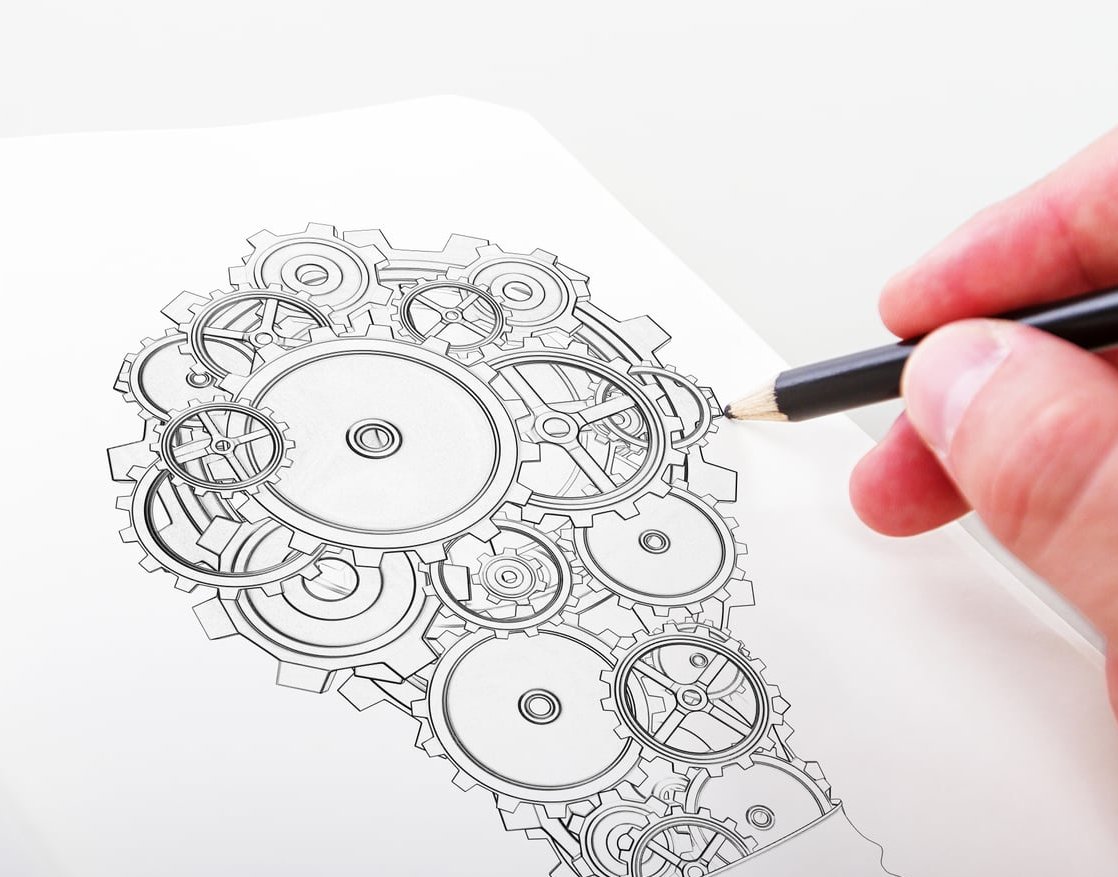
If you’ve ever stared at a blank sketchbook wondering how to sketch a logo without feeling like you need to be the next Da Vinci, this guide is for you. Sketching logos isn’t about drawing skills. It’s about thinking on paper. In this walkthrough, we’ll demystify the process and show you a practical, no-pressure method that pro designers actually use.
Forget the intimidation. Grab a pencil. Let’s get into it.
Why Sketching Still Beats Going Straight to Digital
Before we dive into the steps, let’s settle one thing: paper-first design isn’t outdated. It’s the fastest way to generate ideas. Here’s why every serious logo designer still keeps a sketchbook nearby:
- Speed: You can sketch 30 ideas in the time it takes to vector one in Illustrator.
- Freedom: No layers, no tools, no distractions. Just thinking.
- Better concepts: Software pushes you toward what’s easy to make, not what’s right for the brand.
- Happy accidents: A wobbly line on paper often sparks the best ideas.
You don’t need to draw well. You need to think well. Big difference.
What You Need Before You Start Sketching
Keep the toolkit minimal. Overbuying supplies is procrastination in disguise.
| Tool | Why You Need It |
|---|---|
| A regular HB or 2B pencil | Easy to erase, good range of line weight |
| Plain printer paper or a small sketchbook | Cheap, disposable, encourages quantity |
| A black fine liner pen | For refining the sketches you like |
| An eraser | Obviously |
| A ruler (optional) | For grids or geometric marks |
That’s it. Don’t buy a tablet yet. We’re not there.
Step 1: Brief Yourself Before You Sketch
You can’t sketch a logo if you don’t know what it’s for. Spend 15 minutes answering these questions in writing:
- What does the brand do?
- Who is the audience?
- What three adjectives describe the brand personality? (e.g. playful, bold, trustworthy)
- Who are the competitors and what do their logos look like?
- What should the logo never look like?
Write a short list of keywords based on this. These keywords are the fuel for your sketches.
Step 2: Mind Map and Word Association
Before any shapes, brainstorm with words. Take your keywords and explode them into related ideas.
Example: if your keyword is “coffee shop,” branch out with: bean, cup, steam, morning, sunrise, mug, ceramic, foam, leaf, warmth, conversation.
Now you have visual hooks. This is where logo concepts come from, not from staring at Pinterest.
Quick tip
Aim for at least 30 to 50 words. The obvious ones come first. The interesting ones come after you push past them.
Step 3: Thumbnail Sketches (the Most Important Step)
This is the heart of how to sketch a logo properly. Thumbnails are tiny, rough drawings, typically no bigger than a matchbox. They’re not meant to be pretty. They’re meant to be fast.
How to do it
- Draw a grid of small boxes on your paper. Around 2 inches by 2 inches each. Aim for 12 to 20 boxes per page.
- Set a timer for 20 minutes.
- Fill every box with a different concept based on your word list.
- Don’t erase. Don’t judge. Don’t perfect.
The goal is quantity over quality. Bad ideas unlock good ones. If you produce 40 thumbnails, maybe 3 will be worth developing. That’s a great ratio.
Common thumbnail approaches
- Wordmarks: Play with the brand name in different letter styles.
- Lettermarks: Use just initials.
- Icons or symbols: Pure visual marks.
- Combination marks: Symbol + text together.
- Abstract shapes: Geometric marks that suggest a feeling rather than an object.
- Negative space plays: Hide a second meaning inside the shape.
Step 4: Select and Refine
Walk away for an hour, then come back. Fresh eyes matter.
Circle your top 5 to 8 thumbnails. Look for ones that:
- Communicate the brand’s personality clearly
- Would still read well at very small sizes
- Feel different from your competitors
- Have a unique angle (not a generic icon)
Now redraw each chosen thumbnail at a larger size, around 3 to 4 inches wide. This is where you start refining. Cleaner lines. Better proportions. Pay attention to balance, weight, and how shapes relate.
Step 5: Tighten the Top 2 or 3 Concepts
From your refined batch, pick the strongest 2 or 3. Now use your fine liner pen to ink them. Use a ruler or compass if needed. This is where rough turns into presentable.
At this stage, ask yourself:
- Does it work in black and white only?
- Does it still make sense if I shrink it to the size of a fingernail?
- Is anything visually clumsy or unbalanced?
- Could a 5-year-old describe what it is?
If a concept survives all four questions, you’ve got something worth digitizing.
Step 6: Prep Your Sketch for Digital
Once you have a clean inked sketch you love, scan it or photograph it in good lighting. Bring it into Illustrator, Affinity Designer, or even Figma. Trace it with the pen tool. This is where mathematical precision takes over from human looseness.
The sketch is the soul of your logo. The vector is just the body.
Mistakes Beginners Make When Sketching Logos
- Trying to make every thumbnail perfect. Thumbnails are meant to be ugly.
- Stopping at 5 ideas. The first ideas are usually clichés. Push to 30 or 40.
- Going to the computer too early. You’ll get stuck on details that don’t matter yet.
- Ignoring the brief. A pretty logo that doesn’t fit the brand is worthless.
- Using too many concepts in one logo. One strong idea beats three weak ones stacked together.
The Three Golden Rules of Logo Design (Worth Memorizing)
- Simplicity: A great logo is recognizable in a glance.
- Memorability: If people forget it, it failed.
- Versatility: It must work on a billboard, a business card, and a favicon.
Keep these in mind during every sketch.
Final Thoughts
Learning how to sketch a logo isn’t about being a great illustrator. It’s about thinking visually, generating volume, and being honest about what’s working. The pencil is just the tool. Your brain is doing the heavy lifting.
Start with a brief. Brainstorm with words. Sketch dozens of thumbnails. Refine the best. Ink the winners. Then open the software.
That’s the whole game.
FAQ
Do I need to be good at drawing to sketch logos?
No. Logo sketching is about thinking, not artistry. Most professional logos start as scribbled rough shapes that anyone could draw. If you can write your name, you can sketch logos.
How many sketches should I do before picking a logo?
Aim for at least 30 to 50 thumbnails per project. The first 10 are usually predictable. The interesting ideas come once you’ve exhausted the obvious ones.
Should I sketch on paper or use a digital tablet?
Paper is faster, cheaper, and less distracting for early-stage ideation. A tablet works great once you’re refining a chosen concept, but most pros still start on paper.
What’s the best pencil for sketching logos?
An HB or 2B pencil is plenty. You don’t need expensive supplies. The pencil is just there to get ideas out of your head and onto paper.
How long does the sketching phase usually take?
For a small project, 2 to 4 hours of focused sketching can produce solid concepts. For larger brand projects, designers often spend several days exploring before moving to digital.
Can I skip sketching and just use a logo maker?
You can, but the result will look generic. Logo makers reuse the same templates across thousands of brands. Sketching is what makes a logo truly yours.